Educational
Nannies in the Childcare Workforce: Exploring New Research on Private Household Care With Economist Nancy Folbre
The Pyxie team4 min read
When we talk about the childcare workforce, most people picture daycare centers, preschools, and classrooms. But a substantial amount of childcare happens somewhere else entirely: inside the home.
Nannies and other in-home caregivers are part of that workforce, though their work can be surprisingly difficult to see in the data. They may be grouped into broader categories, counted differently from other childcare workers, or missed altogether.
A recent study by UMass Amherst Ph.D. candidate Aritra Basu and Professor Emerita of Economics Nancy Folbre looks closely at this issue. Published in the U.S. Bureau of Labor Statistics’ Monthly Labor Review, Employment in childcare and early education in the United States, 2000–23 examines how childcare employment has changed over more than two decades.
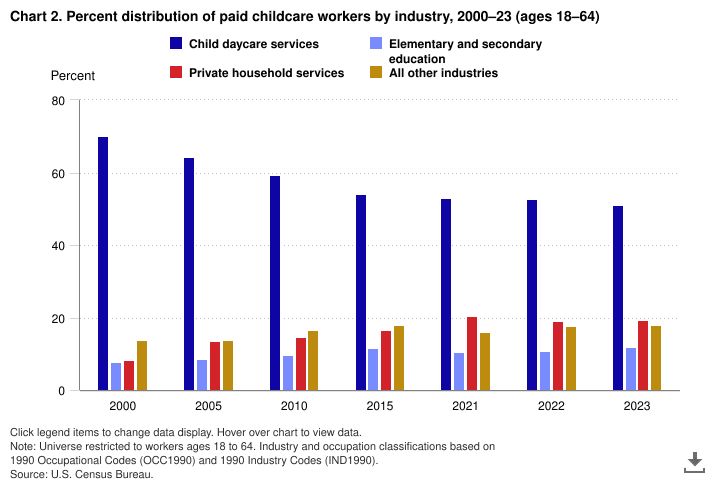
The part we kept coming back to was private household care. Among workers reporting a childcare occupation, the share employed in private household services grew from 8.2% in 2000 to 19.2% in 2023. We wanted to know what might be behind that increase, who those numbers include, and who may still be missing, so we reached out to Nancy to hear what she thought.
A Growing Share of Care Is Happening in Private Homes
When we asked what might be behind the increase, Nancy was candid: “I don’t know of any data that enables us to clearly answer this question.”
She did, however, offer a few possible explanations. Fewer opportunities for young workers, including college graduates, may make nannying more appealing, particularly when a position offers relatively high pay, flexible hours, or the opportunity to travel domestically or internationally with a family.
She also pointed to changing attitudes among affluent parents, especially around early childhood development and the value of individualized care from a well-educated caregiver. Nancy connected this to what some economists call the “rugrat race,” a blunt phrase for the pressure some parents may feel to give their children every possible advantage. Hiring an attentive, highly educated nanny can become part of that effort.
The study can’t tell us which of these explanations carries the most weight. It does show that workers reporting a childcare occupation are distributed differently than they were two decades ago, with a growing share now working in private households.
What the Earnings Numbers Leave Out
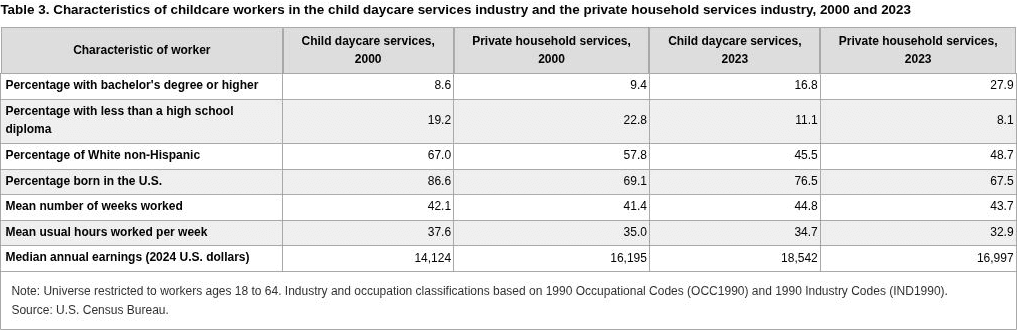
The study also found that private household childcare workers were more likely to have a bachelor’s degree or higher than childcare workers in daycare services. In 2023, the figures were 27.9% and 16.8%, respectively.
The earnings comparison went in the other direction, however. Median annual earnings were $16,997 for childcare workers in private household services and $18,542 for those in daycare services. Both figures are expressed in 2024 U.S. dollars.
“We don’t have very precise measures of hours worked, and no measures at all of non-monetary compensation,” Nancy explained.
Private household caregivers reported working slightly fewer weeks and hours, and some household positions include food or lodging. Nancy also pointed to health insurance and retirement benefits, which have historically been limited for household workers.
The figures don’t tell us what a particular nanny earns per hour or what’s included in the full compensation package. Jobs inside private homes vary too much for one annual salary number to explain all of the contracted terms, benefits, and arrangements.
Who’s Missing From the Count?
Some caregivers may not appear in labor-force surveys at all. The BLS article notes that private household childcare workers are likely undercounted, including informal caregivers who work “under the table.” Nancy also mentioned concerns about immigration status and limited English fluency as reasons why some workers may be less likely to respond to a survey.
Counting people is one challenge, but describing what they actually do inside a home is another.
Nancy offered an example from her own childhood. Growing up in Texas in the 1950s and 60s, her family had a live-in housekeeper. Nancy and her siblings would come home from school, and this woman was often the only adult there with them.
Her job title was housekeeper, but that title left out the care she was providing.
The same overlap exists in household jobs today. Someone may prepare lunch, watch a toddler, help an older child with homework, fold laundry, and make sure everyone gets where they need to be. When one role includes both household and childcare responsibilities, the title someone reports may only describe part of the job.
All of this makes in-home care difficult to measure clearly. The work doesn’t always fall under one title, and some of the people doing it may not appear in the data at all.
Why This Matters to Pyxie
In-home care occurs outside of the public view, which makes the people doing it harder to see in the workforce data. At Pyxie, we spend a lot of time thinking about the work happening inside family homes, including the judgment, communication, and responsibility that rarely fit neatly into a job title.
This research gives us a clearer view of where that work is happening while showing how much remains difficult to capture. We’re grateful to Aritra and Nancy for studying it, and to Nancy for taking the time to talk through the findings with us.
Until next time!
Study Referenced
Basu, A., & Folbre, N. (July 2026). “Employment in childcare and early education in the United States, 2000–23.” Monthly Labor Review, U.S. Bureau of Labor Statistics. https://doi.org/10.21916/mlr.2026.19